
Faculty








Home
The Department was incepted in the year 1996 with Bachelors degree in the faculty of Electrical and Electronics Engineering and is accredited by National Board of Accreditation (NBA) for three times since 2003.The sanctioned student intake is 90. We strive to give our students a holistic learning experience aiding their professional growth with a blend of academics, co-curricular and extra-curricular activities in the right proportion.
Vision
To promote the Department of Electrical and Electronics Engineering as a pioneer in education and research by imparting quality education, creating and upgrading the academic facilities and inculcating professional values to the students to face the challenges in the dynamic global society.
Mission
To attain utmost qualities of teaching-learning process and provide a vibrant environment for the students to exhibit their fullest potential in the field of Electrical and Electronics Engineering.
To improve research and development skills among students towards providing technical solutions with ethical values to meet social challenges.
To develop the students to face the technological requirements of the industry with professional values and make them employable and to impart the spirit of entrepreneurship for their successful career.
Program Educational Objectives (PEO)
Students Corner
Industrial Visit
An Industrial visit gives the student knowledge and exposure needed to grasp certain engineering techniques and terminologies for easier understanding. An in-plant training increases a student's. opportunity of get a job after graduation. An in-plant training adds more experience to the portfolio of the student
(Academic Year - 2025 - 2026)
(Academic Year - 2024 - 2025)
(Academic Year - 2024 - 2025)
(Academic Year - 2023 - 2024)
(Academic Year - 2023 - 2024)
National Level Technical Symposium
Placements
Placements Click Here
Overall Placement Record
| S.No | Academic year | No of Students |
|---|---|---|
| 1. | 2024-2025 | 103 |
| 2. | 2023-2024 | 107 |
| 3. | 2022-2023 | 130 |
| 4. | 2021-2022 | 145 |
| 5. | 2020-2021 | 133 |
| 6. | 2019-2020 | 129 |
| 7. | 2018-2019 | 131 |
| 8. | 2017-2018 | 101 |
| 9. | 2016-2017 | 91 |
| 10. | 2015-2016 | 96 |
| 10. | 2014-2015 | 91 |
Guest Lecture
(Academic Year - 2025 - 2026)
(Academic Year - 2024 - 2025)
(Academic Year - 2023 - 2024)
(Academic Year - 2022 - 2023)
IEEE societies and clubs
Academic Achievements
CO-Curricular Activities
Higher studies
(Batch : 2020 - 2024)
(Batch : 2019 - 2023)
(Batch : 2018 - 2022)
NGO Visits
NGO Vists Click Here
Academics
Syllabus
Syllabus U.G 2021 Regulation # (For the students admitted in 2024 – 2028 Batch) Click Here
Syllabus U.G 2021 Regulation # (For the students admitted in 2023 – 2027 Batch) Click Here
Syllabus U.G 2021 Regulation # (For the students admitted in 2022 – 2026 Batch) Click Here
Syllabus U.G 2021 Regulation # (For the students admitted in 2021 – 2025 Batch) Click Here
Newsletter
March 2026 Click Here
February 2026 Click Here
January 2026 Click Here
December 2025 Click Here
November 2025 Click Here
October 2025 Click Here
September 2025 Click Here
August 2025 Click Here
July 2025 Click Here
June 2025 Click Here
May 2025 Click Here
April 2025 Click Here
March 2025 Click Here
February 2025 Click Here
January 2025 Click Here
December 2024 Click Here
November 2024 Click Here
October 2024 Click Here
September 2024 Click Here
August 2024 Click Here
July 2024 Click Here
June 2024 Click Here
May 2024 Click Here
March 2024 Click Here
February 2024 Click Here
January 2024 Click Here
Research
Staff Patents
Patent details 2024 Click Here
Patent details 2023 Click Here
Patent details 2022 Click Here
Staff Publications
Publications details Click Here
FDP
FACULTY ACTED AS RESOURCE PERSONS IN FDP Click Here
FDP ORGANIZED BY THE DEPARTMENT Click Here
FACULTY ATTENDED BY STAFF MEMBERS Click Here
Funded Projects
Funded Projects Click Here
Consultancy Projects
Consultancy Projects Click Here
Mou
Mou detailsClick Here
Supervisor Details
| Name of the Supervisor | Area of Specialization | No.of students | No. of students completed |
|---|---|---|---|
| Dr.T.V. Narmadha | Soft Computing | 08 | 04 |
| Dr.M.Ramesh Babu | Power System, Renewable Energy Sources | 06 | 05 |
| Dr.T.D.Sudhakar | Power Systems ,Renewable Energy Sources | 05 | 02 |
| Dr.V.Krishnakumar | Power Electronics | 07 | 02 |
| Dr.M.Venmathi | Power Systems, Renewable Energy Sources | 06 | 01 |
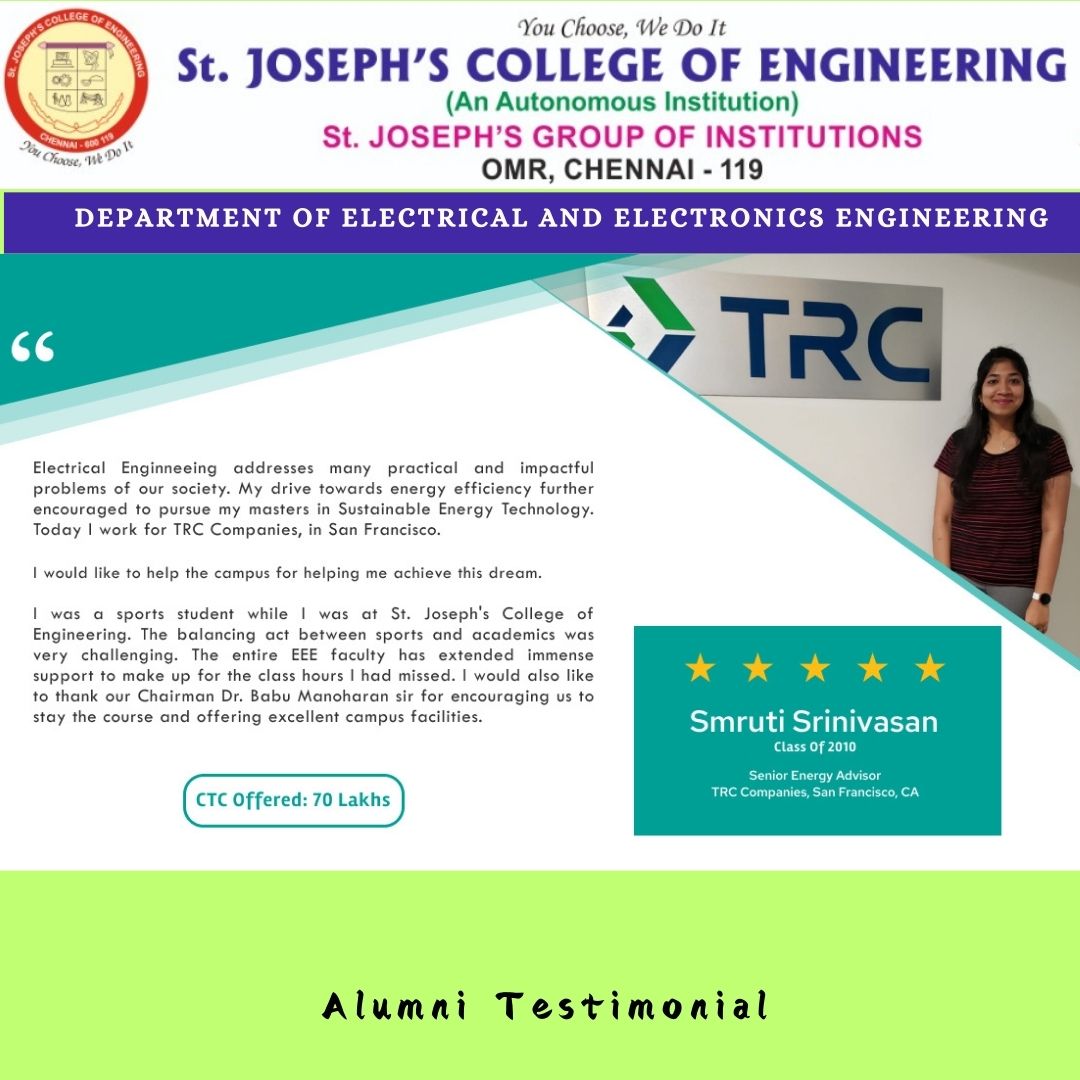
Elite Alumni



Video
Teaching and Learning Process
Program Outcomes
PO1: Engineering Knowledge:
Apply knowledge of mathematics, natural science, computing, engineering fundamentals and an engineering specialization as specified in WK1 to WK4 respectively to develop to the solution of complex engineering problems.
PO2: Problem Analysis:
Identify, formulate, review research literature and analyze complex engineering problems reaching substantiated conclusions with consideration for sustainable development. (WK1 to WK4)
PO3: Design/Development of Solutions:
Design creative solutions for complex engineering problems and design/develop systems/components/processes to meet identified needs with consideration for the public health and safety, whole-life cost, net zero carbon, culture, society and environment as required. (WK5).
PO4: Conduct Investigations of Complex Problems:
Conduct investigations of complex engineering problems using research-based knowledge including design of experiments, modelling, analysis & interpretation of data to provide valid conclusions. (WK8).
PO5: Engineering Tool Usage:
Create, select and apply appropriate techniques, resources and modern engineering & IT tools, including prediction and modelling recognizing their limitations to solve complex engineering problems. (WK2 and WK6)
PO6: The Engineer and The World:
Analyze and evaluate societal and environmental aspects while solving complex engineering problems for its impact on sustainability with reference to economy, health, safety, legal framework, culture and environment. (WK1, WK5, and WK7).
PO7: Ethics:
Apply ethical principles and commit to professional ethics, human values, diversity and inclusion; adhere to national & international laws. (WK9)
PO8: Individual and Collaborative Team work:
Function effectively as an individual, and as a member or leader in diverse/multi-disciplinary teams.
PO9: Communication:
Communicate effectively and inclusively within the engineering community and society at large, such as being able to comprehend and write effective reports and design documentation, make effective presentations considering cultural, language, and learning differences
PO10: Project Management and Finance:
Apply knowledge and understanding of engineering management principles and economic decision-making and apply these to one's own work, as a member and leader in a team, and to manage projects and in multidisciplinary environments.
PO11: Life Long Learning:
Recognize the need for, and have the preparation and ability for i. independent and life-long learning ii. adaptability to new and emerging technologies and iii. critical thinking in the broadest context of technological change.
Program Specific Objectives
Our Graduate Will be able to
PSO1: Identify, understand and analyse the problems in the field of electrical and electronics engineering by applying the principles of mathematics, science and engineering.
PSO2: To apply modern engineering tools and smart techniques to provide socially acceptable technical solution for real time electrical engineering problems focussed on sustainable development.
PSO3: To exhibit leadership qualities, adapt to changing industrial needs and contributes towards the electrical community globally.
Program Educational Objectives
PEO1:To provide a strong foundation for students to have a successful career in electrical and its related fields and to pursue higher education and research.
PEO2:To improve their mathematical and scientific knowledge to solve emerging real world problems related to power, electronics, control systems, field theory and signal processing and will use their communication and intellectual skills for execution of complex technological solutions.
PEO3:To fulfil the needs of society in solving technical problems using engineering principles, tools and practices, in an ethical and responsible manner, in service to the society.
PEO4:To develop their self-learning capability and adaptability to encounter various complex practical problems in multi-disciplinary engineering projects effectively and undertake leadership roles when appropriate.
PEO5:To promote student's awareness of lifelong learning to enhance and maintain professional skills.
Feedback
Laboratory
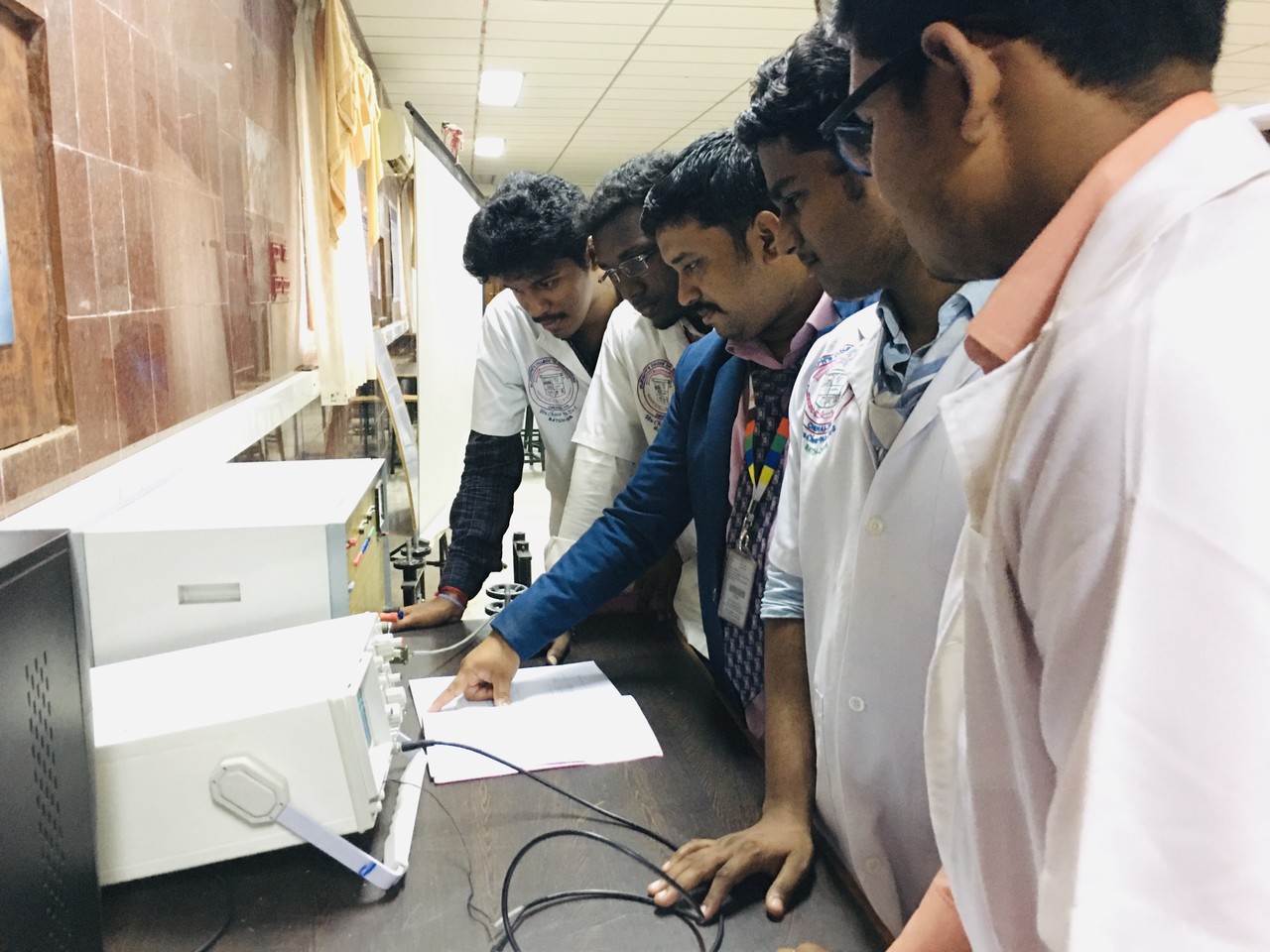
POWER ELECTRONICS LAB
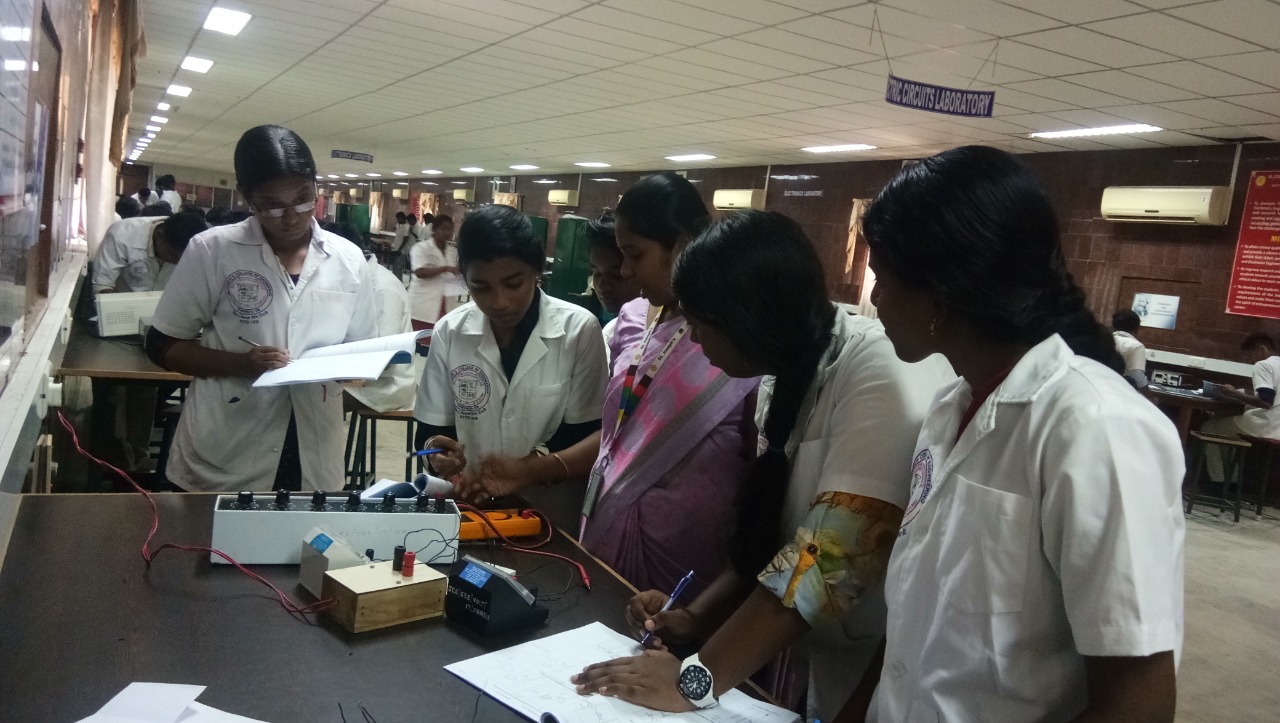
CIRCUITS LAB

POWER SYSTEM SIMULATION LAB
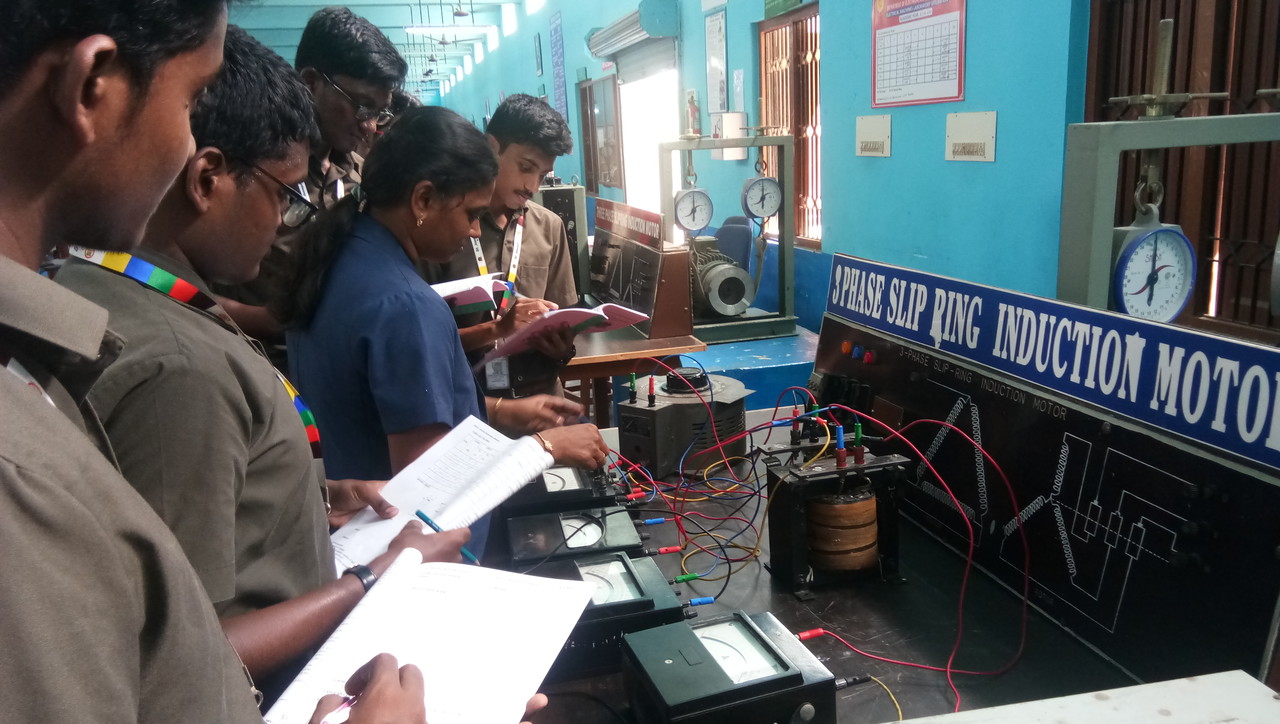
ELECTRICAL MACHINES LAB
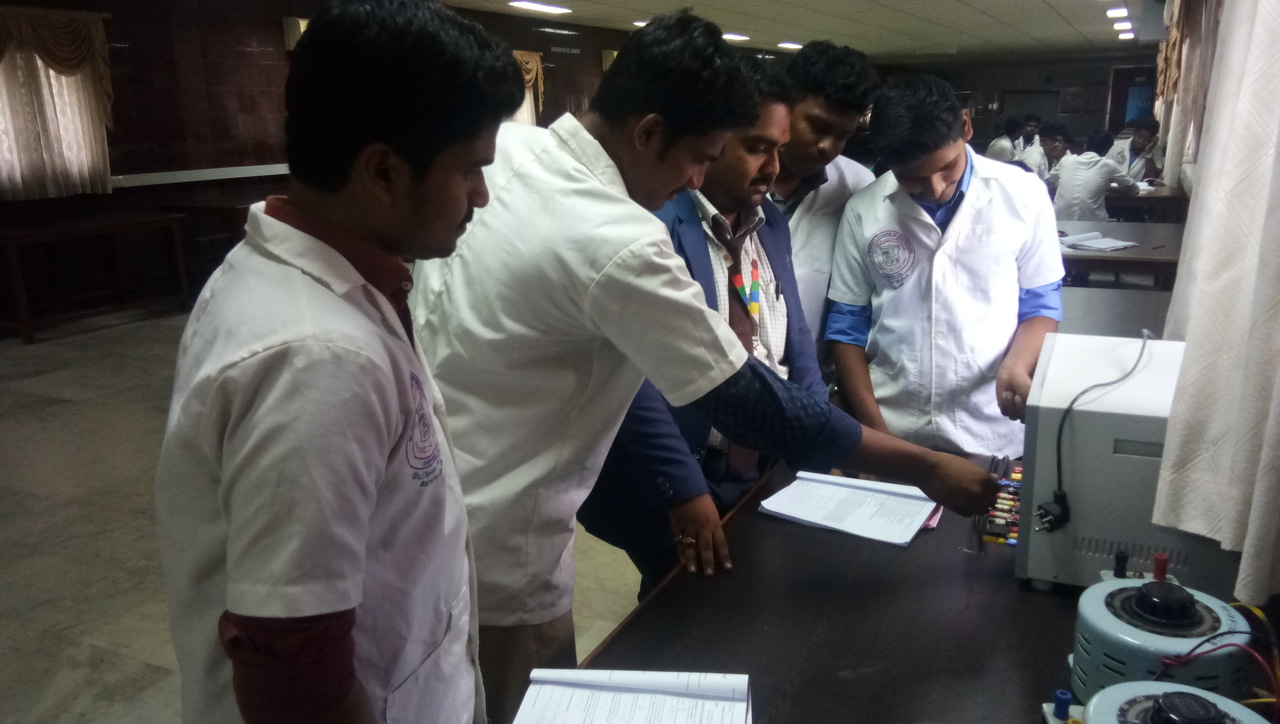
CONTROL AND INSTRUMENTATION LAB
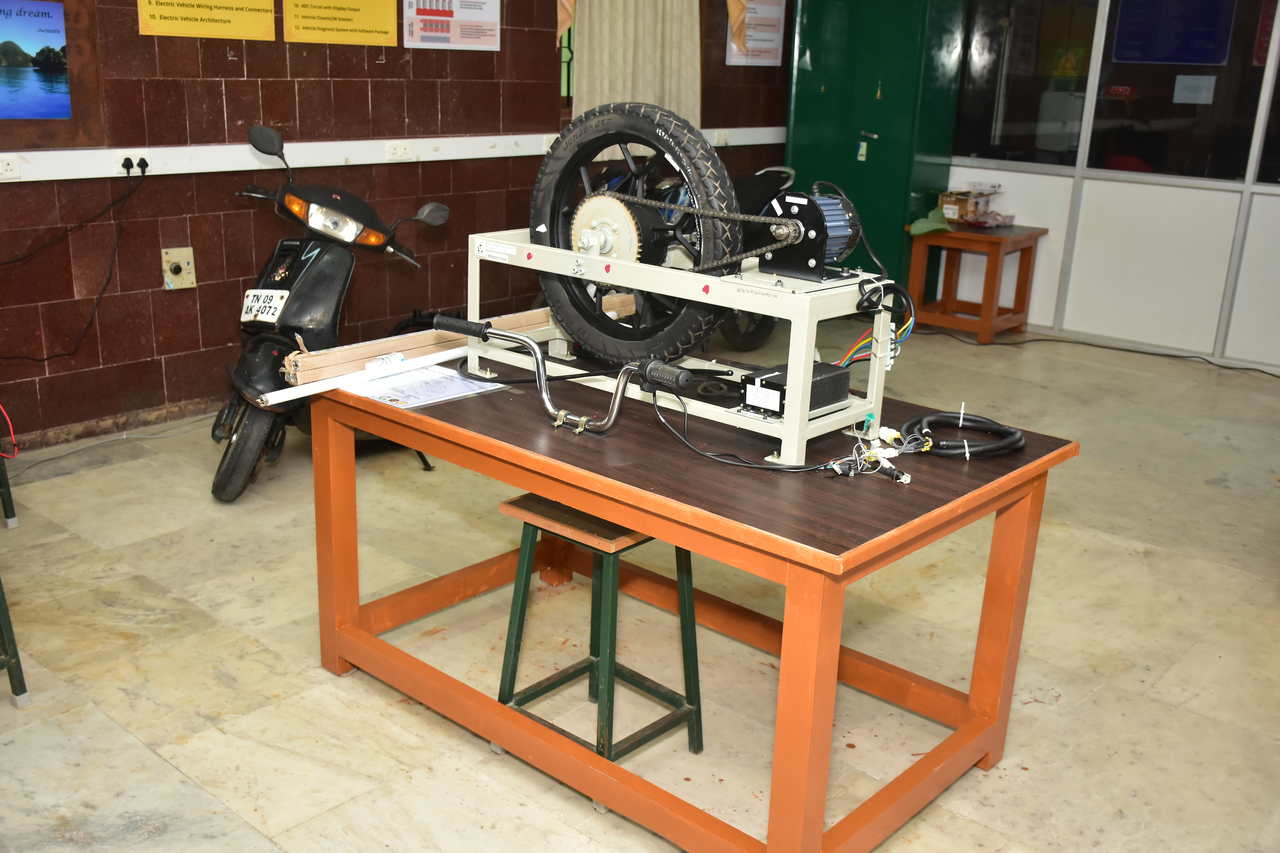
Electric vehicle Lab
Robotics Lab


